 comparison
Injectable Vitamin C Serum: A Complete 2026 Guide
Table of Contents
- What Is Injectable Vitamin C and How Does It Work?
- Benefits of Injectable Vitamins vs Oral Supplements
- Injectable Vitamin C Medical Uses and Clinical Dosage
- Vitamin C Injection Side Effects and Contraindications
- FDA-Approved vs. Compounded Ascorbic Acid: What Buyers Should Know
- How to Source Professional-Grade Skincare Online Safely
- Conclusion
Last Updated: August 27, 2026
What Is Injectable Vitamin C and How Does It Work?
Injectable vitamin C serum is ascorbic acid delivered directly into the body via intravenous, intramuscular, or subcutaneous routes, bypassing the digestive system entirely. This delivery mechanism changes the pharmacology fundamentally, it is not simply a stronger version of an oral supplement. Ascorbic acid is a water-soluble vitamin that functions as an essential enzyme cofactor and antioxidant. Because humans cannot synthesize it endogenously, we depend entirely on external sources. When that supply is interrupted or absorption is compromised, clinical consequences range from fatigue and impaired wound healing to scurvy.
Ascorbic Acid as an Enzyme Cofactor and Antioxidant
Ascorbic acid operates at the cellular level as both an enzyme cofactor and a free radical neutralizer. As a cofactor, it is required for collagen synthesis, catecholamine biosynthesis, and carnitine metabolism. Without adequate ascorbic acid, these enzymatic processes stall, producing wide-ranging symptoms. The antioxidant function is equally important: ascorbic acid donates electrons to neutralize reactive oxygen species, reducing oxidative stress in tissues. This cellular repair role is why injectable formulations attract interest in both clinical and aesthetic medicine. High serum concentrations achieved through systemic administration can exceed what oral dosing alone can reliably produce.
IV vs. Intramuscular vs. Subcutaneous Administration
The three primary routes of injectable vitamin C administration differ in speed, peak serum concentration, and clinical suitability.
| Route | Onset | Peak Serum Level | Typical Clinical Use |
|---|---|---|---|
| Intravenous (IV) | Immediate | Highest achievable | Severe deficiency, high-dose therapy |
| Intramuscular (IM) | 15-30 minutes | Moderate-high | General supplementation, wellness |
| Subcutaneous | 30-60 minutes | Moderate | Maintenance dosing, self-administration |
Intravenous administration delivers ascorbic acid directly into the bloodstream, producing the highest serum concentration. Intramuscular injection deposits the solution into muscle tissue, where absorption occurs over minutes. Subcutaneous delivery into the fat layer beneath the skin is slower. For therapeutic applications targeting severe vitamin C deficiency, the intravenous route remains the clinical standard.
Benefits of Injectable Vitamins vs Oral Supplements
The core argument for injectable vitamins comes down to bioavailability. Oral supplementation is convenient, but the digestive system imposes a hard ceiling on how much ascorbic acid actually reaches systemic circulation.
Bioavailability: Why the Intravenous Route Changes Everything
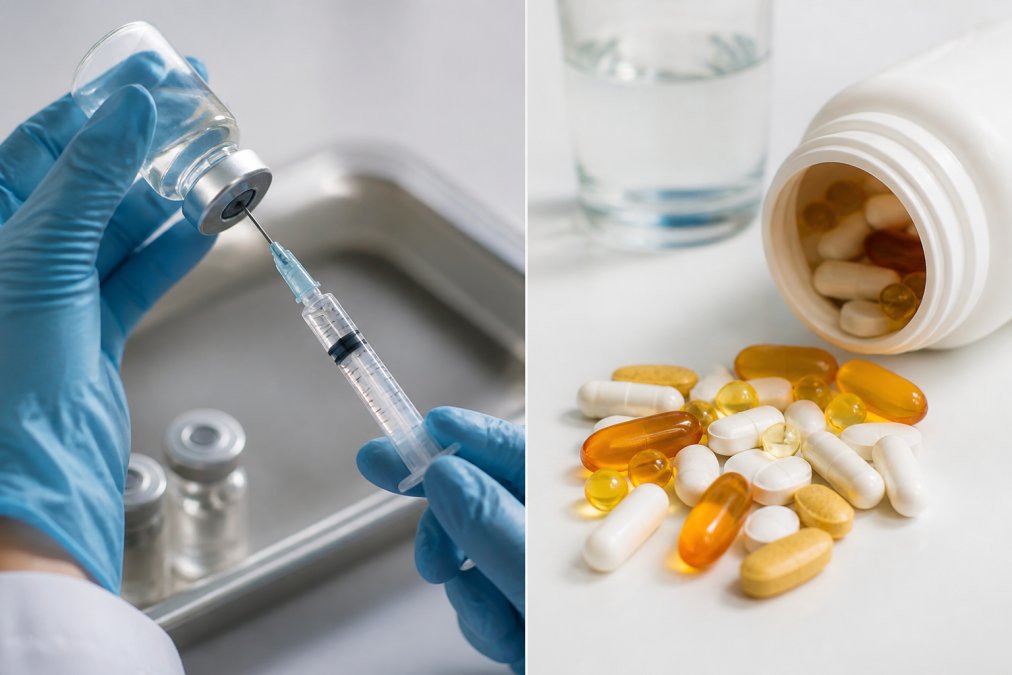
Bioavailability is the fraction of an administered dose that reaches systemic circulation in an active form. For oral vitamin C, bioavailability is dose-dependent and subject to intestinal absorption limits. As oral doses increase, the fraction absorbed actually decreases, and excess is excreted renally. The intravenous route eliminates this constraint entirely. Because ascorbic acid is infused directly into the bloodstream, bioavailability approaches 100%. This pharmacological reality is the foundation of high-dose IV vitamin C therapy in clinical settings. As documented in National Institutes of Health Office of Dietary Supplements vitamin C fact sheet, plasma and tissue concentrations of vitamin C are tightly controlled at lower oral doses but can be driven significantly higher through intravenous administration. For individuals with malabsorption conditions, inflammatory bowel disease, or post-surgical gastrointestinal compromise, injectable administration is often the only reliable route to therapeutic serum levels.
Collagen Production, Immune System Support, and Skin Health
Collagen production: Ascorbic acid is a required cofactor for prolyl and lysyl hydroxylase, the enzymes that stabilize the collagen triple helix. Without adequate vitamin C, collagen fibers are structurally weak, manifesting as poor wound healing, fragile capillaries, and degraded connective tissue. Injectable vitamin C supports collagen synthesis more consistently than oral supplementation in individuals with absorption difficulties.
Immune system support: Ascorbic acid accumulates in neutrophils and lymphocytes at concentrations far exceeding plasma levels, supporting both innate and adaptive immune responses. High-dose vitamin C therapy has been studied in clinical contexts for its role in supporting immune function under physiological stress.
Skin health: Ascorbic acid regulates melanogenesis by inhibiting tyrosinase, the enzyme central to melanin production. Systemic administration via injection delivers ascorbic acid to dermal layers that topical serums may not penetrate reliably, addressing hyperpigmentation and supporting a more even skin tone.
Injectable Vitamin C Medical Uses and Clinical Dosage
The medical applications of injectable ascorbic acid span from treating acute deficiency to supporting aesthetic outcomes. Clinical dosage varies significantly depending on the indication, the route of administration, and the patient's baseline serum concentration.
Treating Vitamin C Deficiency and Scurvy
Vitamin C deficiency is more common than many assume, particularly among older adults, smokers, individuals with limited dietary variety, and those with chronic malabsorption conditions. Severe deficiency produces scurvy, characterized by bleeding gums, petechiae, joint pain, and impaired wound healing. According to FDA guidance on dietary supplement labeling and nutrient deficiency claims, the established daily value for vitamin C in adults is 60 mg, though clinical treatment of deficiency typically involves substantially higher doses administered under medical supervision. Injectable ascorbic acid is the preferred treatment for severe deficiency because oral supplementation may not correct low serum concentrations quickly enough in symptomatic patients. Self-diagnosis and self-treatment of suspected deficiency is not appropriate; a blood test is the only reliable way to confirm low serum ascorbic acid.
Aesthetic Applications: Hyperpigmentation and Depigmentation
Injectable vitamin C has attracted significant interest in dermatology for its depigmentation effects. Hyperpigmentation, including melasma, post-inflammatory hyperpigmentation, and age spots, results from excess melanin deposition. Ascorbic acid interrupts melanogenesis by inhibiting tyrosinase activity and reducing oxidized dopaquinone back to DOPA, slowing melanin synthesis. The aesthetic case for systemic administration over topical application rests on penetration depth and consistency of delivery. Intramuscular or intravenous ascorbic acid delivers the compound systemically, reaching skin cells through circulation rather than surface diffusion.
Vitamin C Injection Side Effects and Contraindications
Injectable vitamin C is generally well-tolerated at appropriate clinical dosages, but adverse reactions are possible and certain patient populations face meaningful contraindications.
Common Adverse Reactions and Therapeutic Index Considerations
The therapeutic index of ascorbic acid is relatively wide. Common adverse reactions at standard doses include injection site discomfort, redness, or bruising; nausea or gastrointestinal discomfort if high doses are administered too rapidly via IV; headache or lightheadedness; and temporary flushing.
More serious concerns arise in specific patient populations. Individuals with glucose-6-phosphate dehydrogenase deficiency face a risk of hemolytic anemia with high-dose IV vitamin C. Patients with renal impairment should exercise caution because ascorbic acid is metabolized to oxalate, and high doses can increase the risk of calcium oxalate kidney stones. beauty supplements for skin.
Contraindications include:
- Known G6PD deficiency (high-dose IV is contraindicated)
- Significant renal impairment or history of calcium oxalate nephrolithiasis
- Hemochromatosis or other iron overload conditions
- Known hypersensitivity to ascorbic acid formulations
As outlined in MedlinePlus drug information on ascorbic acid injection, patients should disclose all medications and health conditions to their prescribing physician before initiating injectable vitamin C therapy.
Post-Procedure Aftercare Protocols
Following an intramuscular or subcutaneous injection: apply gentle pressure to the injection site for 30-60 seconds to minimize bruising; avoid vigorous exercise involving the injection site muscle for 24 hours; monitor the site for signs of infection; stay well-hydrated; and avoid taking additional high-dose oral vitamin C supplements on the same day without medical guidance.
Following intravenous infusion: remain seated or reclined for 10-15 minutes post-infusion; eat a light snack before or immediately after infusion to reduce nausea risk; and report any unusual symptoms to the administering clinician immediately.
FDA-Approved vs. Compounded Ascorbic Acid: What Buyers Should Know
ASCOR Ascorbic Acid Injection USP is the first and only FDA-approved injectable ascorbic acid product. Manufactured by McGuff Pharmaceuticals, ASCOR is produced under federal current good manufacturing practices in an FDA-inspected facility. It is tested for the absence of corn allergens, amino acids, proteins, and polypeptides, and contains no dyes, fillers, or preservatives. It is available in 500 mg/mL concentration in 50 mL vials and requires a medical license to purchase and administer.
Compounded ascorbic acid preparations are not FDA-approved but are legally produced under Section 503A or 503B of the Federal Food, Drug, and Cosmetic Act. Compounded formulations offer flexibility that manufactured products cannot: preservative-free options, corn-free sources, and customized concentrations. Quality depends entirely on the compounding pharmacy's adherence to USP standards and state pharmacy board requirements.
What buyers should verify when sourcing compounded injectable vitamin C:
- The pharmacy holds a valid state pharmacy license
- The facility is accredited by PCAB (Pharmacy Compounding Accreditation Board) or equivalent
- Products are prepared under USP 797 sterile compounding standards
- A valid prescription is required
- The product includes a certificate of analysis from an independent laboratory
As clarified by FDA guidance on compounded drug products under Section 503A, compounded preparations are not FDA-approved and should not be represented as equivalent to FDA-approved drugs. FDA-approved means verified safety, efficacy, and manufacturing quality. Compounded means customizable but requires careful vetting of the source pharmacy.
How to Source Professional-Grade Skincare Online Safely
Sourcing injectable vitamin C serum online requires more scrutiny than buying a topical moisturizer. The stakes are higher, the regulatory landscape is more complex, and the quality variance between suppliers is significant.

A common mistake is treating price as the primary quality signal. Injectable products that appear dramatically cheaper than comparable offerings from licensed distributors should prompt immediate questions about sourcing, storage conditions, and regulatory status.
What to look for in an online supplier:
- SSL certification and industry-standard security protocols
- Clear product descriptions including concentration, volume, and formulation details
- Transparent policies on damaged items and order resolution
- Registered user discounts reflecting a legitimate repeat-customer relationship
- A product range demonstrating category expertise
Buy-Otc.com carries injectable vitamin C products alongside a broader range of injectables, including B12 shots, B1 injections, and B6 injectables, as well as needles and specialized skincare. The site operates with GeoTrust SSL protection and maintains a customer service standard focused on reliable resolution for damaged or incorrect orders. For registered users, discounts and special offers are available.
The question of whether an online supplier is legitimate comes down to verifiable security infrastructure, transparent product sourcing, and a demonstrable track record of resolving customer issues. A site that cannot answer basic questions about product origin, storage conditions, or return policy should not be trusted with injectable medical supplies.
Confirm the supplier's shipping protocols for temperature-sensitive items before ordering, particularly during summer months or for long-distance delivery.
Injectable vitamin C serum sits at the intersection of clinical medicine and consumer wellness, which makes sourcing decisions more consequential than most supplement purchases. Ensuring the product is properly manufactured, appropriately prescribed, and sourced from a verifiable supplier protects both your health and your investment.
Buy-Otc.com offers a secure, customer-focused platform for sourcing injectable vitamin C and related products, backed by GeoTrust SSL protection and a five-star customer service commitment. Browse the current product range and register for member discounts at Buy-Otc.com.
Frequently Asked Questions
Is injectable vitamin C more effective than oral supplements?
For most healthy adults, oral vitamin C works well. The difference appears at higher doses: the gut limits absorption through a process called saturation, so oral intake above roughly 1,000 mg produces diminishing returns in serum concentration. The intravenous route bypasses this entirely, delivering ascorbic acid directly into the bloodstream and achieving plasma levels that oral supplementation cannot match. This bioavailability gap is why clinicians choose injectable vitamin C for treating deficiency, supporting wound healing, and addressing oxidative stress therapeutically.
What are the main vitamin C injection side effects to know before starting?
The most common adverse reactions are mild and localized: pain, redness, or swelling at the injection site. Systemic effects can include nausea, flushing, and headache, particularly at high intravenous doses. People with kidney disease face a higher risk because excess ascorbic acid is excreted renally, and very high doses can contribute to kidney stone formation. Those with glucose-6-phosphate dehydrogenase (G6PD) deficiency should avoid high-dose IV vitamin C entirely. Always discuss your medical history with a licensed provider before starting injectable vitamin C serum therapy.
Can you buy injectable vitamin C online without a prescription?
Regulatory requirements depend on the product type. ASCOR, the only FDA-approved injectable ascorbic acid in the U.S., requires a prescription and purchase through authorized distributors. Compounded ascorbic acid injections from licensed compounding pharmacies also require a valid prescription. Some over-the-counter vitamin C shot products are marketed for wellness use, but buyers should verify the source, confirm the product meets current good manufacturing practices, and ensure the seller operates with proper security and quality standards before purchasing injectable vitamin C serum online.
How long does a vitamin C injection last in the body?
Vitamin C is a water-soluble vitamin, so the body does not store it the way it stores fat-soluble nutrients. After an intravenous or intramuscular injection, plasma ascorbic acid levels peak within minutes to hours depending on the route and dose, then decline as the kidneys excrete the excess. Tissue saturation can persist longer than serum concentration suggests, but the pharmacological effect on immune system support, collagen production, and free radical neutralization is generally maintained for 24 to 72 hours before another dose is needed for continued therapeutic benefit.
What should you look for when sourcing injectable vitamins online?
Check that the seller uses industry-standard SSL encryption to protect your payment and personal data. Look for products that are either FDA-approved or sourced from licensed compounding pharmacies operating under USP Chapter 797 sterile compounding standards. Confirm the concentration is clearly labeled (e.g., 500 mg/mL), and verify whether the formulation is preservative-free if that matters for your use case. Reputable online retailers will also offer responsive customer service and a clear policy for damaged or incorrect shipments, which matters especially for temperature-sensitive injectable vitamin C serum products.
This article was written using GrandRanker