 comparison
B6 Injection vs Oral Pills: Absorption Rates Compared
Table of Contents
- B6 Injection vs Oral Pills: A Direct Comparison
- Vitamin B6 Absorption and Bioavailability: How Each Route Works
- How Long Vitamin B6 Takes to Work: Injection vs Oral
- Vitamin B6 Side Effects and Nerve Damage: What to Watch For
- Who May Benefit from a B6 Injection vs Oral Pills
- Dose Equivalence and Clinical Indications for B6
- Conclusion: Making the Right Choice for Your B6 Needs
- Frequently Asked Questions
Last Updated: October 15, 2026
B6 Injection vs Oral Pills: A Direct Comparison
Vitamin B6, also called pyridoxine, is one of the most widely purchased supplements in the country, and the question we hear most often is simple: does a B6 injection actually absorb better than an oral pill?
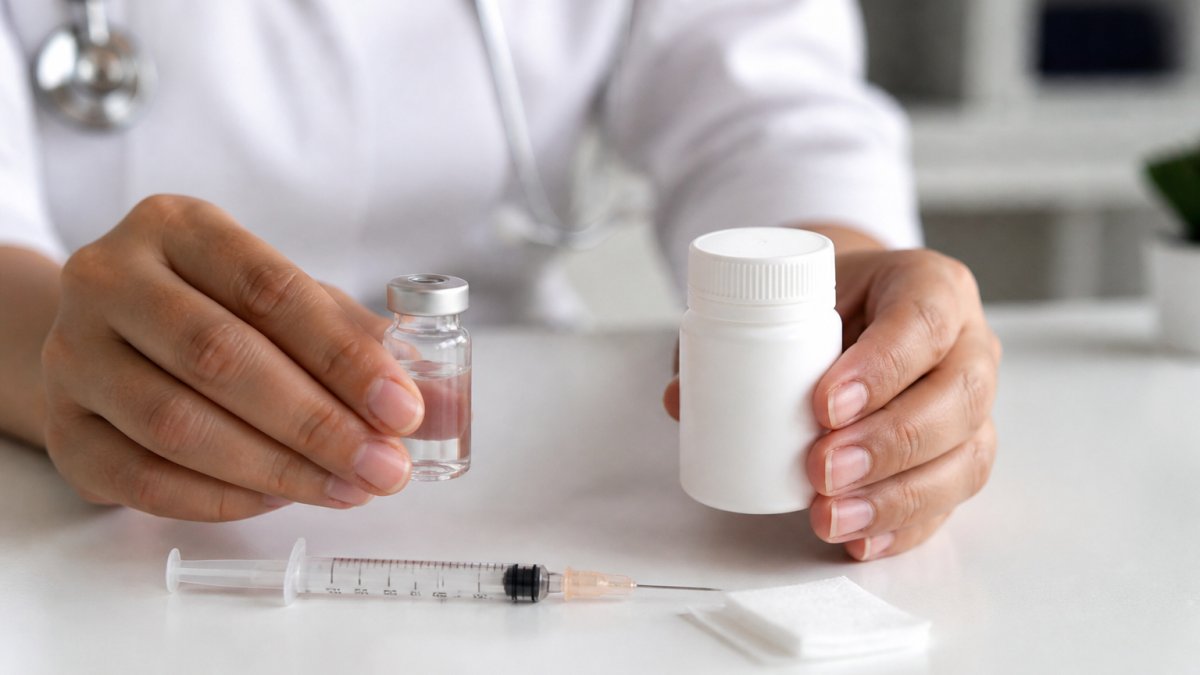
Here is the honest part most guides skip: there is no large head-to-head trial that puts a number on B6 injection absorption versus oral B6 absorption in healthy adults. The clinical references we rely on, including the StatPearls clinical review of vitamin B6, treat oral pyridoxine as the standard form and reserve injectable B6 for specific situations such as severe deficiency, malabsorption, and certain pregnancy-related conditions.
Comparison Table: B6 Injection vs Oral Pills
| Factor | B6 Injection | Oral B6 Pill |
|---|---|---|
| Route | Intramuscular shot | Swallowed tablet or capsule |
| Absorption | Direct into muscle, bypasses gut | Through stomach and intestine |
| Speed of response | Faster | Slower, depends on digestion |
| Best for | Malabsorption, severe deficiency | Routine daily supplementation |
| Convenience | Requires needles and technique | Take with water, anywhere |
| Main risk | Injection site reaction | Nerve damage at high doses |
| Typical use | Short-term, clinician-guided | Long-term, self-managed |
Vitamin B6 Absorption and Bioavailability: How Each Route Works
Bioavailability is the share of a dose that reaches your bloodstream in a usable form, and for B6 the two routes differ in ways specific to pyridoxine rather than borrowed from B12.
Once inside the intestinal cell, pyridoxine is phosphorylated and then dephosphorylated to cross into the blood, after which the liver converts it to the active coenzyme form, pyridoxal 5'-phosphate (PLP).
Intramuscular injection skips the gut and the first-pass liver step. Pyridoxine is deposited into muscle and taken up by local blood vessels, reaching circulation without depending on intestinal transporters or gut health.
That assumption of a working gut breaks down more often than people expect. According to Mayo Clinic's pyridoxine drug reference, certain conditions increase the body's need for vitamin B6, and the same reference covers both oral and injection routes precisely because the right choice varies by patient.
A few practical factors shift oral absorption up or down:
- Dose size: smaller doses are absorbed more efficiently as a percentage; large single doses are absorbed less completely.
- Formulation: pyridoxine hydrochloride is the standard supplemental form; enteric coatings and sustained-release designs change release timing but not the fundamental carrier limits.
- Food and timing: taking B6 with food slows gastric emptying and can smooth absorption; an empty stomach tends to produce faster but sometimes less complete uptake.
- Gastrointestinal conditions: celiac disease, Crohn's disease, bariatric surgery, and chronic diarrhea can all reduce the intestinal surface available for uptake.
- Medications: certain drugs, including some anticonvulsants, isoniazid, and penicillamine, interfere with B6 status or metabolism and are a recognized reason clinicians monitor levels.
How Long Vitamin B6 Takes to Work: Injection vs Oral
An injection produces a measurable rise in blood levels faster than a pill, often within hours rather than days, because there is no digestion step to wait on. Oral B6 still works, but absorption, liver processing, and distribution all add delay before you feel any difference.
What most people get wrong is expecting either route to fix symptoms overnight. Vitamin B6 supports the breakdown of proteins, carbohydrates, and fats, and rebuilding a depleted store takes consistent intake over time. A shot may correct a severe deficit more quickly, but it is not a switch you flip.
- Injection: blood levels rise within hours; symptom improvement typically follows over days to weeks
- Oral pill: blood levels rise over days; steady status builds across weeks of consistent dosing
- Either route: full correction of a deficiency is measured in weeks, not doses
If you are tracking your own response, judge it across a few weeks, not on day one, whether you inject or swallow.
Vitamin B6 Side Effects and Nerve Damage: What to Watch For
The most serious risk with vitamin B6 is not the injection itself. It is cumulative dose, and it applies to both routes.
This is where the injection-versus-pill comparison gets interesting. Because injections absorb more completely, a given dose delivers more active vitamin to your nervous system, an advantage when correcting a real deficiency, a liability when self-dosing high amounts for energy or mood without any measured shortfall.
Watch for these signs and stop if they appear:
- Tingling or numbness in fingers or toes
- Burning sensations in the feet
- Unsteady walking or clumsiness
- Sensitivity to touch that was not there before
The NIH Office of Dietary Supplements fact sheet on vitamin B6 is a good plain-language reference for upper intake guidance. Our advice is blunter: do not run high-dose B6 for months on end without a reason and a plan to stop.
Who May Benefit from a B6 Injection vs Oral Pills
An injection is the better choice when absorption is the bottleneck. If you have a diagnosed malabsorption condition, have had gastrointestinal surgery, or take a medication that interferes with nutrient uptake, oral B6 may never get you where you need to be no matter how faithfully you take it.
For everyone else, pills are usually the smarter pick: easier, with a wider safety margin, and no needles, sterile technique, or sharps disposal.
A quick way to decide:
- Choose injection if: you have confirmed malabsorption, a severe deficiency, or a clinician has recommended it
- Choose oral if: you want routine support, have a healthy digestive system, and prefer simplicity
- Reassess if: you have taken oral B6 for months with no change in symptoms
That last point is the one people skip. If oral B6 is not working, the answer is not always a stronger dose, sometimes it is a different route, and sometimes a different diagnosis entirely.
Dose Equivalence and Clinical Indications for B6
There is no clean conversion between an injected dose and an oral dose, and anyone who gives you a simple ratio is guessing.
When injectable B6 is genuinely used. Injectable pyridoxine is a defined, narrow tool rather than an everyday form. Clinicians reach for it in these situations:
- Severe deficiency with symptoms, such as a frank neuropathy or a seizure presentation in an infant, where rapid correction matters and oral intake may be unreliable.
- Documented malabsorption, including short bowel syndrome, bariatric surgery, and active inflammatory bowel disease, where the intestinal surface cannot do the job.
- Drug-induced deficiency, most classically isoniazid treatment for tuberculosis, where pyridoxine is co-prescribed to prevent neuropathy; the route and dose are set by the treatment protocol, not by preference.
- Certain pregnancy-related conditions, including hyperemesis gravidarum, where a clinician may use the injectable form when oral intake is not tolerated.
- Inborn errors of metabolism such as pyridoxine-dependent epilepsy, a rare condition where high-dose pyridoxine is a specific treatment and the route is a clinical decision.
Outside those situations, oral pyridoxine is the standard form, and the StatPearls review of pyridoxine treats it that way. That is the key point most comparison articles miss: the route is not a lifestyle choice, it is a response to a diagnosis.
What the established intake numbers actually say. The NIH Office of Dietary Supplements fact sheet on vitamin B6 sets a Recommended Dietary Allowance for adults at roughly 1.3 to 1.7 mg per day depending on age and life stage, and it establishes a Tolerable Upper Intake Level for adults of 100 mg per day from supplements.
Why the B12 comparison does not transfer. Related route-comparison research in vitamin B12, including a peer-reviewed comparison of oral and intramuscular B12, found little difference in medication-only cost between routes. Any article that hands you a B12 absorption percentage and calls it B6 is wrong on the biology.
The evidence-quality caveat. Direct head-to-head trials measuring oral versus injectable B6 absorption in healthy adults are scarce. Most of what is known about B6 pharmacokinetics comes from single-route studies, studies in specific patient populations, and older research using different measurement methods.
If you are deciding on a dose, get it from a clinician who knows your history, not from a conversion table online.
Conclusion: Making the Right Choice for Your B6 Needs
The absorption gap is real, and it favors injections for anyone whose gut cannot do the job. For most people taking B6 for general support, a pill does the same work with far less fuss. The mistake is treating this as a permanent identity rather than a decision you revisit as your circumstances change.
If injectable B6 is the right route for you, Buy-Otc.com stocks B6 Injectable along with needles, B12 shots, and B1 injections, backed by Geotrust SSL protection for your payment details and a 5 star customer service team that resolves damaged or lost orders. Registered users also get access to ongoing discounts and special offers.
Frequently Asked Questions
Is vitamin B6 absorbed better by injection or by mouth?
Injection delivers B6 directly into the muscle or bloodstream, bypassing the digestive system. This means higher bioavailability and faster absorption, especially for people with malabsorption issues. Oral pills rely on gastrointestinal absorption, which can be reduced by factors like alcohol, certain medications, or gut conditions. However, for most healthy individuals, oral B6 is well absorbed and effective. The choice depends on your specific health status and clinical needs.
What is the most absorbed form of vitamin B6?
Pyridoxal-5-phosphate (P5P) is the active form of B6 and is readily absorbed, but it is less stable and more expensive. Pyridoxine hydrochloride (the common form in pills) is also well absorbed in healthy people. Injectable B6 is typically pyridoxine hydrochloride and offers the highest absorption rate because it bypasses digestion. For most people, oral P5P or pyridoxine works well, but injections may be recommended when rapid correction of deficiency is needed.
Can taking too much vitamin B6 cause nerve damage?
Yes. High-dose oral B6 over long periods can cause peripheral neuropathy, with symptoms like numbness, tingling, or difficulty walking. The risk increases with doses above 200 mg per day, though some cases occur at lower doses. Injectable B6 is usually given under medical supervision and at controlled doses, reducing the risk of toxicity. Always follow recommended dosages and consult a healthcare provider before starting high-dose B6.
How quickly does an oral vitamin B6 pill work compared with an injection?
An injection can raise blood levels within minutes to hours, while oral pills typically peak in the blood after 1 to 2 hours. For correcting a severe deficiency, injections may show faster clinical improvement. However, for mild deficiency or general supplementation, oral B6 can effectively raise levels within days to weeks. The speed of noticeable effects also depends on your baseline levels and overall health.
What can interfere with vitamin B6 absorption?
Several factors can reduce oral B6 absorption, including alcohol consumption, certain medications (like isoniazid, penicillamine, and theophylline), and gastrointestinal conditions such as celiac disease or Crohn's disease. Age can also play a role, as stomach acid production decreases over time. If you have any of these issues, a B6 injection may provide more reliable absorption. Always discuss with your doctor before changing your supplement routine.
Get started with Buy-Otc.com and order your B6 injectable with the needles and supplies to match, all in one secure checkout.