 How-to
Can You Trust a Supplement COA? How to Verify It
Last Updated: November 13, 2026
Quick Summary
To verify a supplement COA, match the lot number on the report to your container exactly, confirm the testing lab independently exists and is accredited, and ask the seller for a lab contact or verification link. Then read every result against its stated limit and flag anything missing, such as no lot number, lab name, method, or signature.
- A complete COA should contain product identity, potency, purity, and contaminant test results tied to a specific batch and lab method.
- A result of 500 mg on the COA means little if the label claims 500 mcg, a thousand-fold difference.
- If the limit of detection is higher than the acceptance limit, the test cannot prove compliance.
- A potency result of 100 mg with uncertainty of plus or minus 5 mg is really a range of 95 to 105 mg.
- A weak COA example reuses the same report across every batch or shows only pass with no numbers.
Table of Contents
- Why a Supplement COA Is Only as Good as Its Verification
- What a Supplement Certificate of Analysis Should Contain
- How to Read a Supplement COA Line by Line
- A Step-by-Step COA Authentication Workflow
- What a Supplement Certificate of Analysis Example Reveals
- Third-Party Tested Supplements and What the Claim Really Means
- NSF Certified Supplements and Other Marks Worth Checking
- What a COA Cannot Prove
- Frequently Asked Questions
Why a Supplement COA Is Only as Good as Its Verification
A supplement certificate of analysis is only as trustworthy as your ability to verify it. The document itself is just paper or a PDF. What matters is whether it matches your exact bottle, comes from a real lab, and reports results against clear limits.
Customers who order injectables and other health products online often want proof before they buy. That instinct is right. A COA you cannot check is worse than no COA at all, because it creates false confidence.
Here is the core problem most buyers miss. Anyone can type a batch number into a template and print a clean-looking report. Verification means checking the report against the product, the lab, and the batch. Below, we walk through exactly how to do that, line by line.
What a Supplement Certificate of Analysis Should Contain
A complete COA should contain four things: product identity, potency results, purity results, and contaminant test results. Each one ties to a specific batch and a specific lab method.
The document should also name the manufacturer, the lot number, the testing lab, the report date, and the analytical methods used. Missing any of these is a warning sign.
Identity, Potency, Purity, and Contaminant Results
Identity testing confirms the ingredient is what the label says. Potency measures how much active ingredient is present against the label claim. Purity checks for unwanted material. Contaminant testing covers heavy metals, microbes, and residual solvents.
Each result should show a measured value, a unit, and a pass/fail mark against a stated limit. A report that says "pass" with no number tells you nothing you can check.
For a plain-language walkthrough of reading the label side of this, see our guide on how to read supplement labels for purity.
How to Read a Supplement COA Line by Line
Reading a supplement COA means matching each line to the label and to the stated limit, then judging whether the number behind that line is meaningful. Start with the header, then move down through identity, potency, and contaminants.
Work in this order:
- Header: product name, lot number, report date, lab name
- Identity line: the tested ingredient versus the label ingredient
- Assay line: measured amount versus label claim, with units
- Contaminant lines: heavy metals, microbial counts, each against a limit
- Footer: lab signature, accreditation mark, method references
Methods, Units, Detection Limits, and Uncertainty
The method column tells you how the lab tested the sample.
Watch the units. Potency is often reported in milligrams or micrograms, and a mismatch between the COA unit and the label unit is a common error.
Detection limits are where most readers get lost. The limit of detection (LOD) is the smallest amount the lab can reliably distinguish from zero (the EPA). The limit of quantitation (LOQ) is the smallest amount the lab can measure with acceptable precision.
Measurement uncertainty is the range around a reported value that the lab attributes to normal analytical variation. A potency result of 100 mg with an uncertainty of plus or minus 5 mg is really a range of 95 to 105 mg.
For a plain-language walkthrough of reading the label side of this, see our guide on how to read supplement labels for purity.
A Step-by-Step COA Authentication Workflow
Authentication is a five-step check: match the batch, confirm the lab, verify the report, read the results, and flag gaps. Each step takes minutes and catches a different kind of problem.
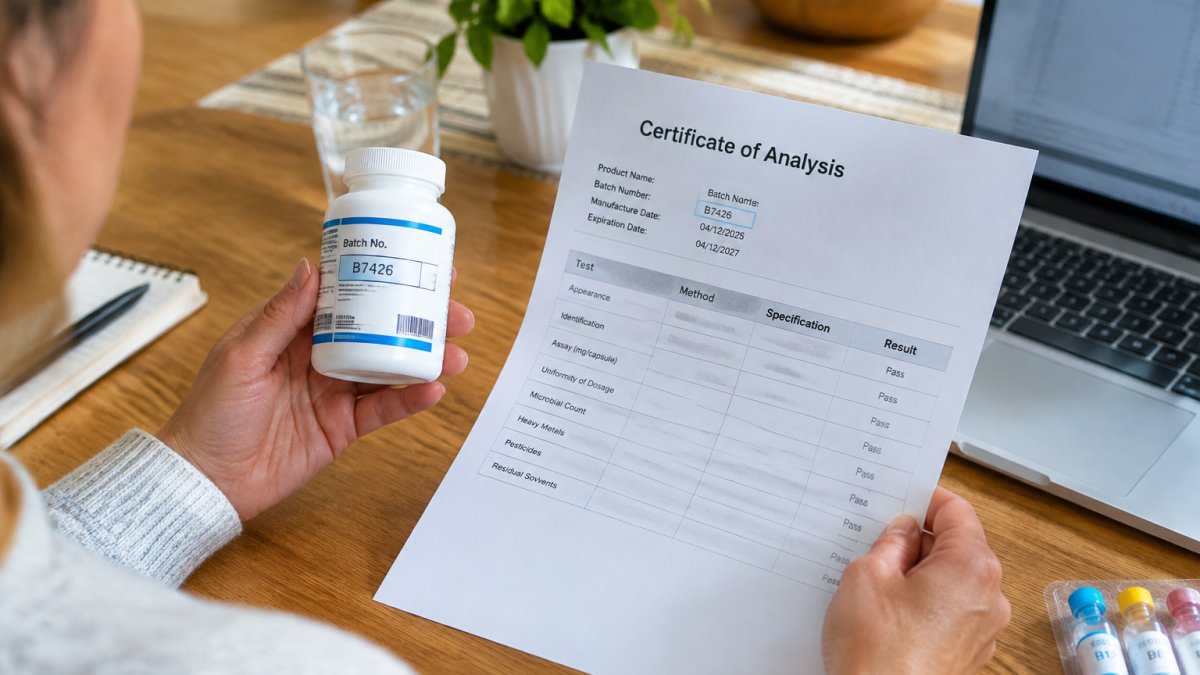
- Match the lot number. The lot or batch number on the COA must match the number on your container exactly.
- Confirm the lab exists. Search the lab name independently. Check it is a real, accredited laboratory, not a name invented for the report.
- Verify the report directly. Ask the seller for a lab contact or a verification link. A genuine lab can confirm it issued the report.
- Read every result against its limit. Look for measured values, units, and pass/fail marks, not just the word "pass."
- Flag anything missing. No lot number, no lab name, no method, or no signature means you cannot authenticate it.
A common mistake is checking only the product name. The lot number is the detail that ties a report to your actual bottle.
Once you can authenticate a report, the next question is where to buy from in the first place. Our guidance on best practices for buying vitamins online covers sourcing checks that pair well with this workflow.
Authentication is a five-step check that catches a different kind of problem at each stage.
| Step | What to do | What it catches |
|---|---|---|
| 1 | Match the lot number to your container exactly | Report not tied to your bottle |
| 2 | Search the lab name independently | Invented lab names |
| 3 | Ask seller for lab contact or verification link | Reports the lab never issued |
| 4 | Read every result against its limit | Reports showing only the word pass |
| 5 | Flag anything missing | No lot, lab, method, or signature |
What a Supplement Certificate of Analysis Example Reveals
A good supplement certificate of analysis example shows a batch-specific report with real numbers, not a generic spec sheet. The difference between the two is the whole point of verification.
Look at what a strong example includes:
- A unique lot number tied to one production run
- Measured values with units for each test
- A stated acceptance limit beside each result
- The lab's name, accreditation, and signature
- A report date that falls within the product's shelf life
A weak example reuses the same report across every batch, shows only "pass" with no numbers, or lists no lab at all. If the report could apply to any bottle, it verifies nothing.
Third-Party Tested Supplements and What the Claim Really Means
"Third-party tested" means an outside lab, not the manufacturer, ran the tests. That is a meaningful claim, but it is only as strong as the lab and the report behind it.
The phrase itself is not regulated as a seal. A seller can print it without proving anything. So treat it as a question to verify, not an answer.
Ask three things:
- Which lab ran the test?
- Is that lab accredited and independent?
- Can you see the batch-specific report?
If the answer to any of these is vague, the claim is marketing until proven otherwise. For context on getting real value without skipping verification, see our buyer's guide to supplement deals.
NSF Certified Supplements and Other Marks Worth Checking
NSF Certified supplements carry a mark from NSF International, an independent certification body. The mark means the product met that program's testing and facility standards, which is a stronger signal than a self-printed claim.
Other marks worth knowing include USP Verified and ConsumerLab. Each program has its own scope, so check what the mark actually covers.
A certification mark is useful, but it is not a substitute for a batch COA. The mark speaks to a product line and its manufacturing. The COA speaks to your specific lot. Use both when you can. The NSF International certification program publishes what its mark does and does not cover, and the FDA's guidance on dietary supplement labeling explains what labels may and may not claim.
What a COA Cannot Prove
A COA cannot prove a product is safe for you, effective for your condition, or legal to import. It reports test results on a sample. It does not assess your health, your medications, or your risks.
This is where buyers overreach. A clean COA is not a green light to skip your own safety checks.
A COA also cannot prove the sample tested is the bottle you received. That is why lot matching and lab verification matter. And it cannot confirm a product is free of every possible contaminant, only those the lab tested for. A report applies to a defined sample and a defined test scope; it does not establish ongoing manufacturing quality, clinical effectiveness, or the contents of every unit in a batch.
When Results Are Missing, Incomplete, or Failed
The most useful skill in COA verification is knowing what to do when the report is not clean.
A missing test. If the COA omits a test you would expect for that product type, ask the manufacturer which tests were run and why the others were not.
A result near a limit. A contaminant result that sits just under the acceptance limit is a weaker signal than one well below it, especially when measurement uncertainty is considered.
A failed result. A failure on the report is not automatically a reason to discard the product, but it is a reason to stop and ask questions.
When any of these gaps appears and the seller cannot resolve it with a specific, checkable answer, the safer choice is to avoid the product.
If you take medication or have a health condition, run the interaction checks first. Our safety checklist for supplement-drug interactions walks through what to confirm. For questions about a specific product's documentation, you can reach our team through our contact page and we will help you get the details you need.
Verifying a supplement COA takes a few minutes and a skeptical eye, and it is the single best habit you can build before buying injectables or any health product online.
Frequently Asked Questions
How do I verify a supplement certificate of analysis is authentic?
Start by matching the batch or lot number on the report to the one printed on your supplement container, then check the report date against the batch's manufacturing window. Contact the laboratory named on the report directly using contact details you find independently, not the ones printed on the document, and ask whether they issued that report number for that client. A genuine supplement COA will be confirmed by the lab. If the lab has no record of it, treat the report as unverified.
Does the FDA verify supplement certificates of analysis?
No. The FDA does not review, approve, or certify supplement COAs before products reach the market. Under the current regulatory framework, supplement manufacturers are responsible for their own quality control, and the FDA steps in after problems are reported. That means a COA is a manufacturer or lab document, not a government certificate. Verification has to come from the laboratory that ran the tests and from your own checks on the batch number, methods, and results.
What are red flags on a supplement COA?
Watch for a report with no batch or lot number, no lab name or signature, and no test methods listed. Results that show only pass or fail with no measured values, units, or acceptance criteria are hard to verify. A report dated years before the batch was made, a COA that is identical across every product a brand sells, or one that cannot be confirmed by the named laboratory are all reasons to ask questions before you buy third-party tested supplements.
What should I look for in NSF Certified supplements?
Check the NSF certification mark on the actual product label and confirm the product appears in NSF's public certified product listing, since certification applies to specific products and facilities, not entire brands. NSF Certified supplements have been reviewed for label claim accuracy, contaminant limits, and good manufacturing practices. A COA and an NSF mark do different jobs: the COA covers one batch, while certification covers ongoing compliance, so the two together give you the strongest picture.